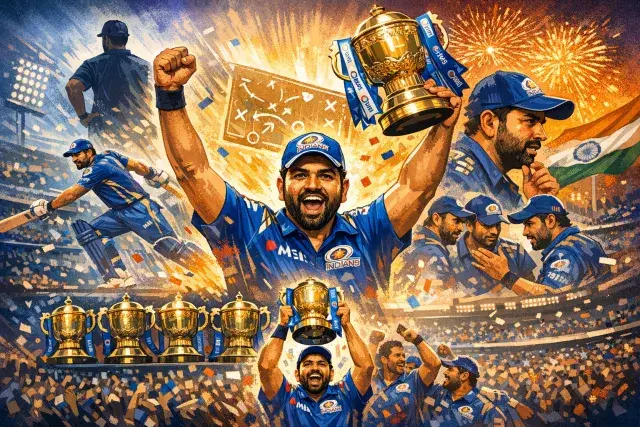
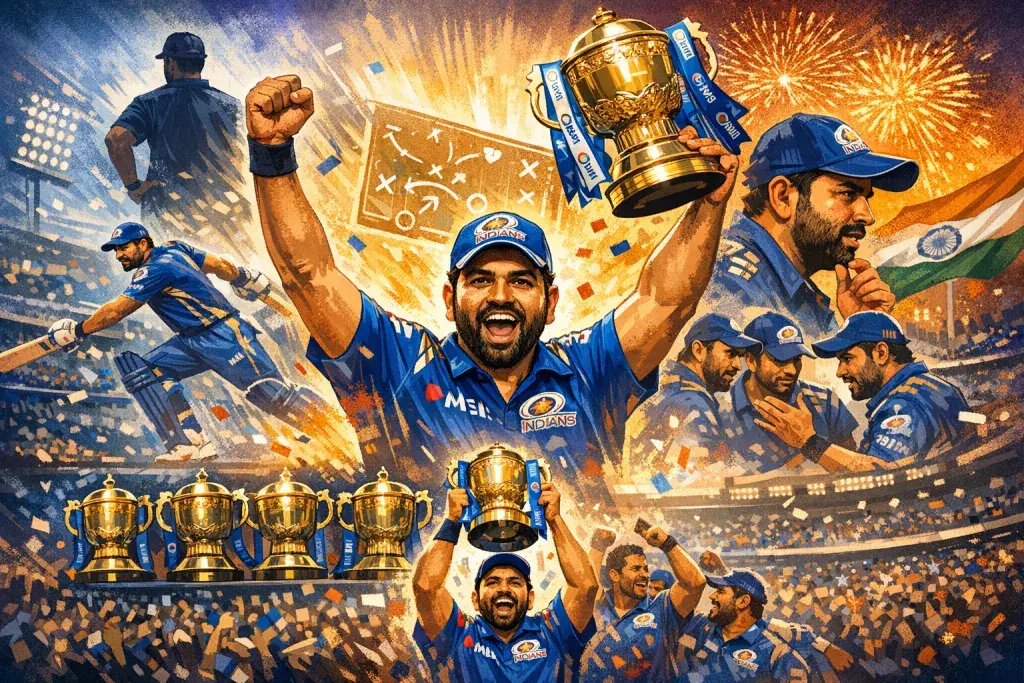
Fifteen years ago, Mumbai Indians paid approximately 9.2 crore rupees to secure Rohit Sharma at auction — a figure that, measured against what followed, stands as one of the shrewdest investments in Indian cricket's professional era. What the franchise acquired was not merely a batsman of rare talent, but a leader whose instincts, temperament, and decision-making would come to define the most successful chapter in the Indian Premier League's history. Rohit Sharma led Mumbai Indians to six IPL titles, a record that no other captain in the format has matched.
A Franchise Transformed by a Single Decision
When Rohit joined Mumbai Indians ahead of the 2011 season, the franchise held one IPL title and occupied a position of unfulfilled promise. He spent two seasons contributing as a senior member of the squad before the ownership made another bold call — handing him the captaincy ahead of the 2013 edition. Few franchises hand full leadership to a 25-year-old without a proven track record in that role. Mumbai Indians did, and the result was immediate.
In his first season at the helm, the side finished second on the points table, advanced through the knockout rounds, and defeated Chennai Super Kings in the final by 23 runs. More striking still, Rohit did not stop there. The same year, he guided the side to CLT20 glory as well, lifting two major titles within a single calendar year. For a first-year captain, that is a level of output that demands serious attention.
The Pattern That Made Mumbai Dominant
What followed over the next several years was a sustained period of dominance rooted in consistent leadership. Mumbai Indians claimed the IPL title in 2015, 2017, and 2019 — a pattern so reliable it became a shorthand observation among cricket commentators. Three titles across consecutive odd-numbered seasons reflected not luck, but an organisational culture that Rohit helped shape and sustain.
The 2020 season added a different dimension to his legacy. Entering as defending title-holders, Mumbai Indians faced the considerable historical weight of the format's near-perfect record of punishing complacency. Only one other side — Chennai Super Kings — had successfully defended the title before. Rohit's side topped the points table with nine wins from fourteen outings and went on to defeat Delhi Capitals twice in the knockout rounds, including a five-wicket victory in the final. That fifth title made Mumbai Indians the most decorated franchise in IPL history at the time, and placed Rohit in a category of leadership that invited direct comparison with MS Dhoni as the format's defining captain.
What Made Rohit's Leadership Distinct
Leadership in high-pressure, short-format cricket is a specific discipline. It requires reading conditions rapidly, managing personnel under intense public and commercial scrutiny, and maintaining collective confidence through the inevitable losses that punctuate any long campaign. Rohit Sharma did all of this across more than a decade with the same franchise — an unusual degree of continuity in a format defined by its volatility.
His approach was characterised by calm under pressure. Observers consistently noted the absence of visible anxiety in his decision-making, even in close finishes. He extended trust to younger members of the squad and was willing to absorb short-term risk for long-term returns — a disposition that is rare and valuable in environments driven by immediate results. Over time, Mumbai Indians became associated not just with winning, but with winning in a particular way: composed, structured, and difficult to unsettle.
A Handover and a Historical Measure
When Mumbai Indians transitioned to Hardik Pandya as captain, they were stepping away from a leadership era that had produced six titles. That transition prompted natural reflection on what Rohit had built — and the answer is a durable institutional identity. His tenure did not merely accumulate trophies; it established a standard of expectation that the franchise now carries forward regardless of who leads it.
Rohit Sharma began his Mumbai Indians journey at auction in 2011, an acquisition framed at the time as expensive and uncertain. What that investment ultimately purchased was a period of dominance without precedent in Indian franchise cricket. Whether that record holds or is eventually surpassed, his place in the conversation about the format's finest leaders is already settled.